
Paris, 1886 – Broke, Vincent van Gogh moves in with his younger brother Theo, a successful art gérant. Over the next two years, Vincent meets the Impressionists, their secular influences well-documented.
Vincent’s original stint as a Parisian denizen, however, came a decade earlier while being groomed for the role Theo would assume. Vincent’s last chance to prove himself a capable art dealer, he was too distracted and obsessed with the scriptures. He hoped, like his father, to spread the gospels; bringing consolation to the suffering. After five years with his uncle’s firm, Vincent was fired, admonished to never set foot in Goupils again.
Vincent retreated to London. On Sunday, October 29th, 1876, he delivered his first sermon at the Wesleyan Methodist Church. He borrowed heavily from John Bunyan’s The Pilgrim’s Progress. The homily was impassioned with Vincent’s belief that we are all pilgrims on earth, on a long, upward road to reconnect with God. Today, art historians are fortunate that he recorded the entirety of those thoughts in a letter to Theo.
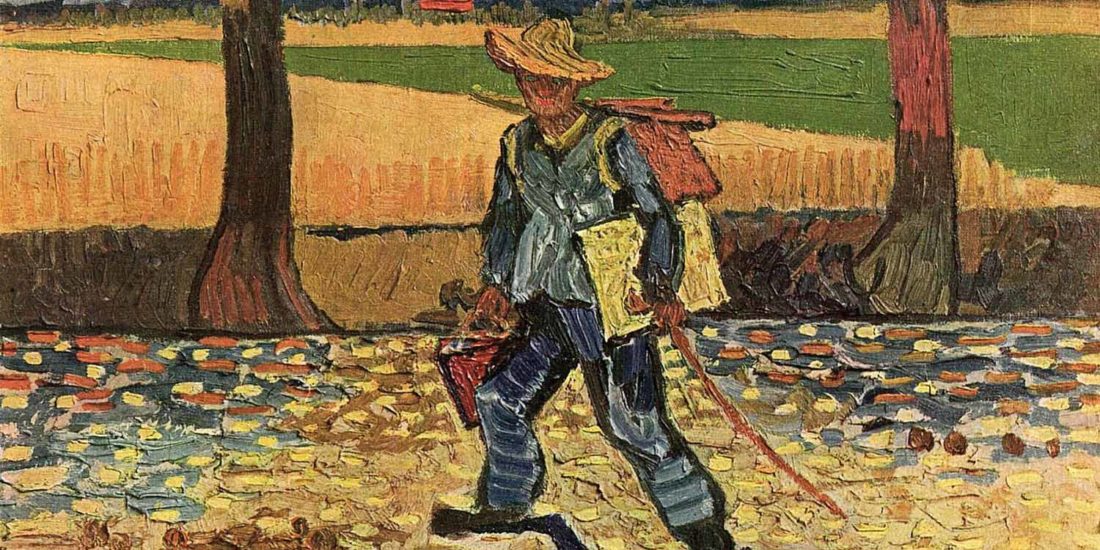
This presentation seeks to refine and redefine Vincent’s complicated Christology, exploring the allegory of the road in dozens of his later sketches, drawings and paintings; arguing, while his style and aesthetics constantly evolved over his ten-year career as an artist, Vincent’s desire to visually spread the gospels remained his raison d’être.
Image: Selection from Vincent van Gogh's Artist on the Road to Tarascon (1888)
Read presenter's biography